
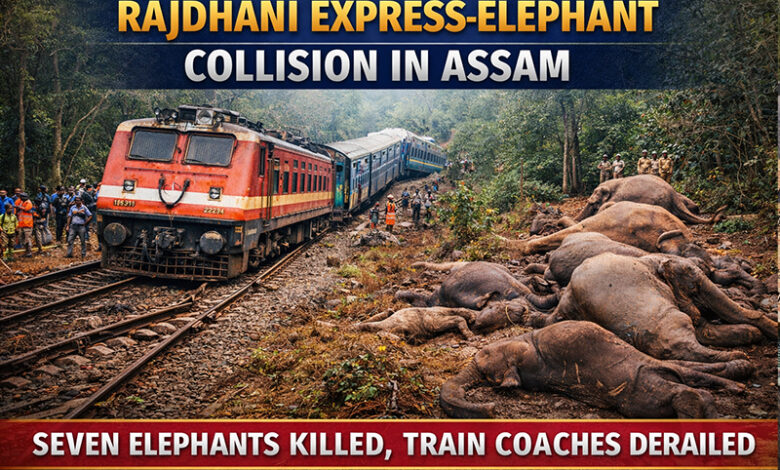
Rajdhani Express–Elephant Collision in Assam Leaves Seven Elephants Dead, Train Coaches Derailed
Hojai District, Assam, December 21:
A tragic wildlife incident unfolded in Assam in the early hours of Saturday when a high-speed Rajdhani Express train collided with a herd of wild elephants crossing the railway tracks, resulting in the deaths of seven elephants and injuries to a calf. The collision also caused the derailment of the locomotive and five coaches, though no human casualties were reported.
The incident occurred at around 2:15 a.m. in the Jamunamukh–Kampur section of the Lumding railway division, a forested stretch in Assam’s Hojai district. Railway officials confirmed that all passengers and crew members on board the train are safe.
Sequence of the Incident
According to preliminary information shared by railway authorities, the train was travelling at permissible speed when it encountered a group of elephants moving across the tracks in low-visibility conditions. Despite the loco pilot applying emergency brakes, the distance and speed involved made it impossible to stop the train in time.
The impact was severe, leading to the derailment of the engine and five coaches. Several elephants were killed instantly, while one injured calf was found alive near the tracks. Forest department teams rushed to the scene to assess the condition of the surviving animal and manage the aftermath.
Railway officials stated that the affected stretch is not officially marked as an elephant corridor, adding complexity to prevention efforts.
Passenger Safety and Immediate Response
Soon after the collision, railway emergency response teams, senior railway officials, and forest department personnel arrived at the site. Passengers were evacuated safely from the derailed coaches and shifted to unaffected compartments. Medical teams were kept on standby, though no injuries were reported among passengers or staff.
The damaged coaches were detached, and restoration work on the tracks began immediately. Rail traffic on the route was temporarily disrupted, with several trains diverted or rescheduled to ensure passenger safety and facilitate track clearance.
Authorities also set up helpline numbers to assist passengers seeking information regarding delays or alternate arrangements.
Impact on Wildlife and Conservation Concerns
The deaths of the elephants have once again highlighted the ongoing conflict between expanding transport infrastructure and wildlife habitats in the northeastern region. Assam is home to a significant population of wild Asian elephants, many of which frequently move between forest areas in search of food, water, and migration routes.
Such movements often intersect with railway lines, particularly in forested belts where human activity and natural habitats overlap. While several railway sections across the country have designated elephant corridors with speed restrictions and monitoring mechanisms, incidents outside these zones remain difficult to predict and prevent.
Wildlife experts note that elephant herds can travel long distances overnight, sometimes altering traditional routes due to habitat fragmentation, human settlements, or seasonal changes.
Official Reactions
Railway officials expressed deep regret over the loss of wildlife and reiterated their commitment to passenger safety and environmental responsibility. Senior authorities stated that safety protocols were followed by the train crew and that the collision occurred under challenging circumstances.
Forest department officials said veterinary teams conducted examinations of the deceased elephants and are providing treatment to the injured calf. They also confirmed that further assessment would be conducted to understand the movement pattern of the herd and identify preventive measures.
Local district authorities have assured cooperation between railway and forest departments to review the incident comprehensively.
Call for Preventive Measures
Environmental groups and conservationists have renewed calls for stronger coordination between transport authorities and wildlife agencies. Suggested measures include enhanced night-time monitoring, advanced animal-movement detection systems, better fencing in vulnerable areas, and real-time alerts for train drivers in forest zones.
Experts have also stressed the importance of conducting regular wildlife movement surveys beyond officially notified corridors, as animal behaviour can change due to environmental and human-induced factors.
While railways play a vital role in connectivity and economic activity, conservationists argue that infrastructure planning must increasingly account for ecological sensitivity, particularly in biodiversity-rich regions such as Assam.
Broader Implications
The Assam elephant-train collision adds to a growing list of incidents that underline the delicate balance between development and conservation. As India continues to expand its rail network and modernise services, the challenge lies in ensuring that progress does not come at the cost of irreplaceable wildlife.
Authorities acknowledge that preventing such incidents requires a multi-layered approach involving technology, policy intervention, field coordination, and community awareness.
Conclusion
As restoration work continues on the affected railway section, services are gradually being normalised. While the absence of human casualties offers some relief, the loss of wildlife has cast a shadow over the incident.
The tragedy serves as a reminder of the urgent need for enhanced safeguards where transport infrastructure intersects with natural habitats. Moving forward, authorities face the task of strengthening safety measures to protect both passengers and wildlife, ensuring that development and conservation move forward hand in hand.
